
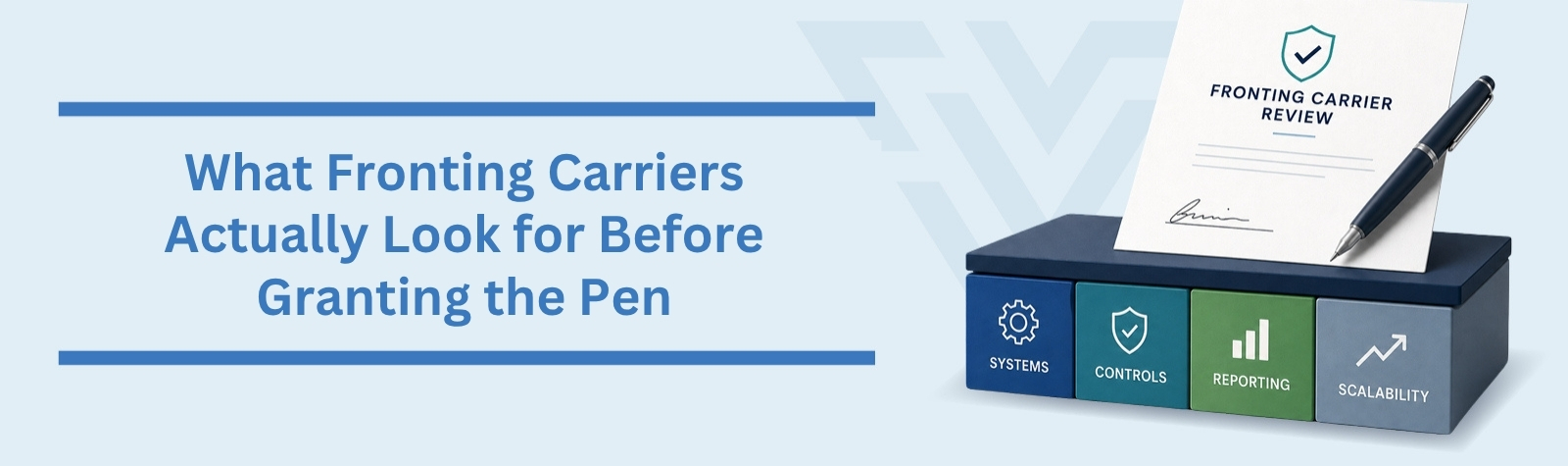
You can have the most aggressive growth projections and the best distribution strategy in the market, but if you walk into a capacity meeting with a fronting carrier and your backend relies on manual data entry, the pen stays in their pocket.
The common disconnect is that MGAs want to talk about scale, but carriers need to see bordereaux and compliance.
Carriers are letting you risk their balance sheet when they grant pen authority. It doesn’t matter how good your current loss ratios are if your infrastructure can’t reliably enforce their rules as you grow. If your reporting is always late or your underwriters have to memorize guidelines, carriers just see a massive, unavoidable risk. The right P&C solutions give carriers the visibility and control to verify that underwriting rules, reporting standards, and compliance requirements will hold as an MGA grows.
To secure capacity and keep it, your operations have to be predictable. Because we build the systems that connect MGAs to their carrier partners, we know exactly what passes due diligence.
The short version
A carrier-ready stack connects rating, policy issuance, underwriting controls and reporting so a fronting carrier can see how its rules are being enforced as an MGA grows. It validates eligibility and required data at the point of sale, routes exceptions, and delivers real-time bordereaux. For a carrier, that makes delegated authority easier to trust and capacity easier to maintain.
Here is what carriers are actively demanding from your tech stack today.
What is a Carrier-Ready Stack?
A Carrier-Ready Stack refers to the integrated operational software and data infrastructure an MGA uses to automatically enforce a fronting carrier’s underwriting guidelines, manage compliance, and stream real-time bordereaux reporting. For MGAs evaluating P&C insurance software products, the key is how well rating, policy issuance, and reporting work together to support carrier requirements. By connecting core rating engines to automated policy issuance, a carrier-ready stack guarantees that risk appetite is strictly controlled at the point of sale, regardless of submission volume.
The Death of the 30-Day Rearview Mirror
The industry used to accept delayed, end-of-month reporting. Today, forcing a carrier to wait 30 days to see how their capital is performing is a great way to lose a partnership.
Real-time visibility changes the entire dynamic. Carriers can spot portfolio trends, track aggregate limits, and monitor underwriting issues the moment they happen. You eliminate the endless back-and-forth emails and manual data reconciliations. Instead of constantly defending your decisions, you build a transparent, high-trust relationship.
Easily Configurable Guardrails
Carriers understand that underwriters need flexibility, but they also need confidence that underwriting rules are applied consistently as volume scales. Relying on manual judgment alone introduces variability that becomes difficult to control across a growing book of business.
The strongest MGAs operationalize carrier requirements within their underwriting workflows in a way that is both enforced and easily configurable as business conditions change:
- Eligibility Validation: Preventing ineligible risks from progressing through the submission process
- Required Data Enforcement: Ensuring submissions are complete before they can be quoted or bound
- Pricing Controls: Applying approved rating logic consistently across submissions
- Authority Thresholds: Automatically routing exceptions when submissions exceed defined limits
For MGAs, insurance rating software helps put these pricing controls into practice by applying carrier-approved rating logic during quoting.
When these controls are system-enforced but fully configurable by the MGA without code changes, carriers gain confidence that underwriting intent is consistently applied, while the MGA retains the ability to adjust rules as products, appetite, and market conditions evolve.
Untangling the Data Mess
Data readiness often gets ignored until there’s a reporting crisis. As your premium volume grows, a patchwork infrastructure of disconnected systems, spreadsheets, and inconsistent naming conventions will eventually break under the strain.
Carriers are looking for standard data formats (such as ACORD or AL3 standards), centralized policy management, and automated API data syncing. They want predictable bordereaux reporting delivered exactly how they need it, every single time. If your back office is unorganized they will hesitate to expand your capacity.
Building for Scale (Without Tearing Down Your Business)
Carriers are evaluating whether your operations will hold up when your submission volume triples. But achieving that scalability does not mean you have to shut down your business to build a massive, from-scratch software platform. When evaluating P&C insurance software solutions, look for the flexibility to strengthen your existing operations as carrier requirements and submission volumes change.
This is exactly why West Point Technologies was built. We know MGAs do not need a disruptive greenfield solution that takes years to deploy. You do not need to throw away systems that already work. Instead, West Point provides a modular solution. We connect your existing tools, automate your workflows, and layer in the real-time reporting and configurable underwriting guardrails that carriers demand.
That flexibility matters when comparing P&C insurance software vendors: the right provider should strengthen the systems that already work while closing gaps in automation, reporting, and operational control.
West Point plugs the gaps in your infrastructure so your team can focus on writing great business.
Frequently asked questions
Why do fronting carriers ask for real-time reporting? They need to see portfolio trends, aggregate limits and underwriting issues as they develop, rather than wait for an end-of-month report.
Which controls should an MGA put in its workflow? Eligibility checks, required data, approved pricing logic and authority thresholds should be applied consistently, with exceptions routed for review.
Does becoming carrier-ready require replacing existing systems? No. A modular approach can connect systems that already work and add the reporting and configurable underwriting guardrails a carrier needs.
If you are an MGA looking to handle more volume and prove to the market you are a capacity-worthy partner, we should talk. Reach out to the team at West Point Technologies, and let’s get your operations carrier-ready.
About the Author
T. John Jerger, Jr. is the COO & Co-Founder of West Point Technologies. With nearly 30 years of executive experience in Florida’s property and casualty insurance industry, he was instrumental in designing and building West Point’s automated quoting, rating, policy issuance, and inquiry systems, which currently prevent data entry errors and allow 95% of issued policies to require no human intervention at inception. In addition to his leadership at West Point Technologies, John serves as President and CEO of American Traditions Insurance Company and TJ Jerger MGA, bringing deep institutional knowledge of the complex Florida homeowner marketplace and capacity management.
